R-005 Correlations2026.11.078 min read
The Language You Inherited Is Already Thinking For You
On language, culture, perception, and the invisible architecture of thought.
What if the way you understand the world is, to a considerable extent, an inheritance you never consciously agreed to?
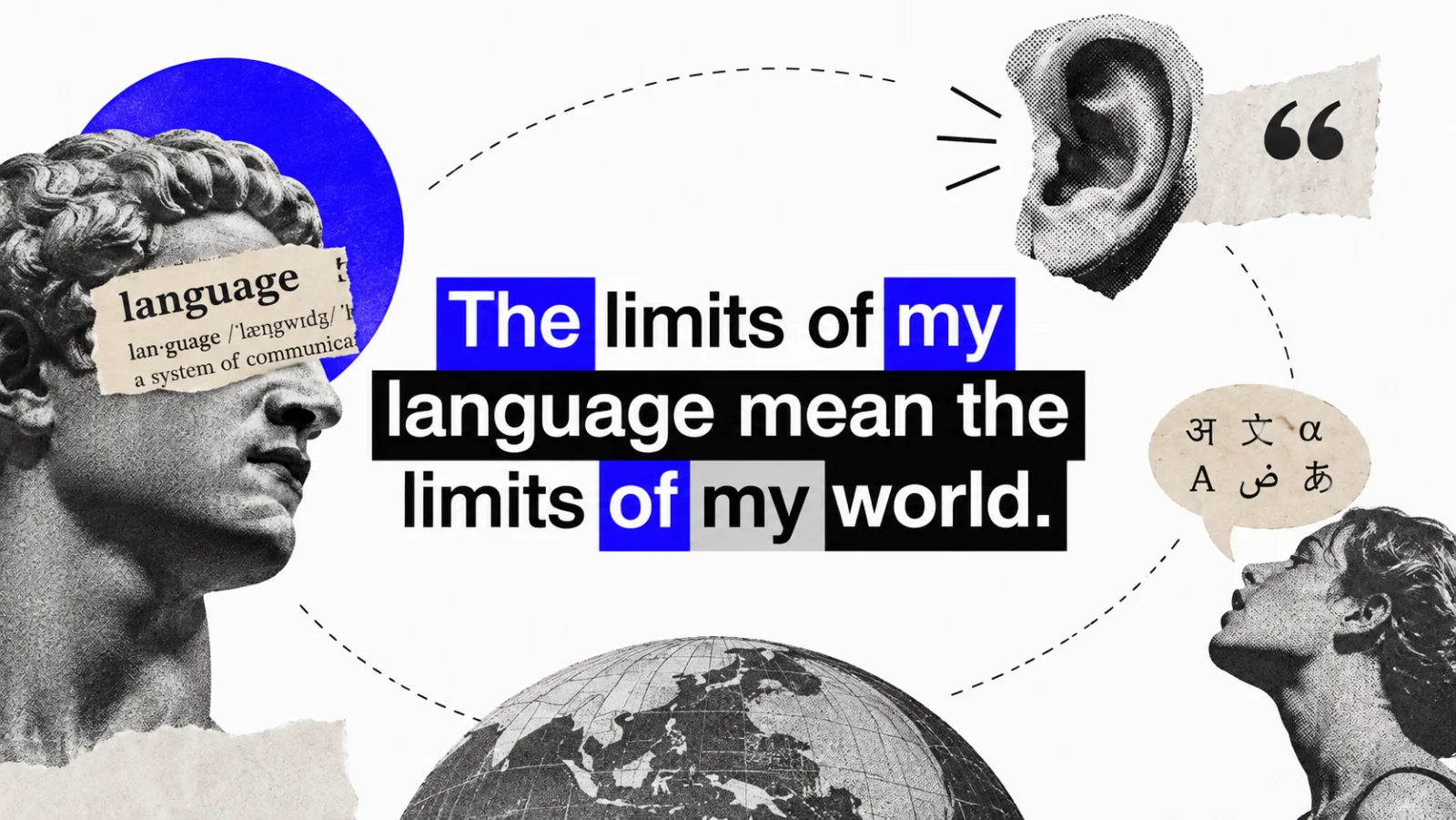
I recently found myself going down a rabbit hole about languages and their relationship with cultures. I wasn’t particularly interested in grammar, vocabulary or the usual business of learning how to speak another language. I was more interested in something else. Why do different cultures develop such remarkably different ways of understanding and interacting with the world? Why do certain societies seem to develop extraordinary competencies in particular domains, while others cultivate entirely different strengths? And what determines these differences in the first place?
I started looking at geography, history, economics, social structures and eventually language. The more I explored the subject, the more interesting the relationship became. Language seemed to be doing something much more fundamental than simply allowing people to communicate. It was participating in the construction of how they perceived, categorised and made sense of their surroundings.
Which led me to a slightly uncomfortable thought.
Before we get the opportunity to develop our own worldview, we have already inherited the conceptual machinery through which we are going to develop it.

01 — Language is an architecture, not merely a medium
We generally understand language as a medium for transferring thoughts between people. I think this is a rather limited understanding of what language actually does.
Language is also a cognitive framework. It provides us with categories, distinctions, metaphors and relationships through which reality becomes intelligible. It influences what we pay attention to, how we organise information and what kinds of distinctions become important enough to remember.
The human brain is already selective in how it processes information. We don’t absorb reality as an uninterrupted stream of objective information. We constantly filter, categorise and interpret it using prior knowledge.
Language participates in this process by supplying the conceptual structures through which we organise our experiences.
Consider how differently two societies might conceptualise something as fundamental as time, space or direction. What seems like an obvious and universal way of understanding something to one population might be entirely unfamiliar to another.
This is precisely what makes linguistic anthropology so fascinating. It allows us to examine how different linguistic systems participate in producing different habits of thought.
The philosopher Ludwig Wittgenstein famously suggested that the limits of our language mean the limits of our world. Although this doesn’t mean we are incapable of thinking beyond our vocabulary, it raises an important question. How much of what we consider reality is actually a consequence of the conceptual frameworks through which we encounter it?

02 — Different languages, different cognitive priorities
One of the most fascinating studies I encountered was conducted by psychologists Lera Boroditsky and Alice Gaby in 2010, involving the Kuuk Thaayorre-speaking Aboriginal community of Pormpuraaw in Australia.
Unlike English speakers, who predominantly use relative directions such as left and right, Kuuk Thaayorre speakers frequently use absolute geographical directions such as north, south, east and west.
What makes this interesting is what researchers discovered about their representation of time.
Participants were asked to arrange pictures depicting temporal progressions, such as the ageing of a person or the development of an object. English speakers generally arranged these sequences from left to right. The Kuuk Thaayorre speakers, however, tended to arrange them from east to west, regardless of which direction they were physically facing.
Think about the implications of that.
For many English speakers, the representation of time is organised around the body and its relationship with space. In this community, temporal organisation was associated with an absolute geographical framework.
Their habitual use of directional language, combined with their broader cultural and environmental practices, was associated with a different way of organising temporal information.
It is a fascinating example of how something as seemingly fundamental as the passage of time can be mentally represented through different conceptual systems. (Boroditsky and Gaby, 2010; Gaby, 2012)
And this is where my original curiosity about cultural differences became considerably more interesting. Perhaps what we often interpret as differences in people’s natural abilities or tendencies can sometimes be partly understood through the cognitive habits their environments have cultivated.
Not because language makes one population inherently better than another, but because different environments repeatedly train people to notice, remember and prioritise different things.
03 — The things your language teaches you to distinguish
Another study, published in PNAS in 2007, examined how Russian and English speakers distinguish colours.
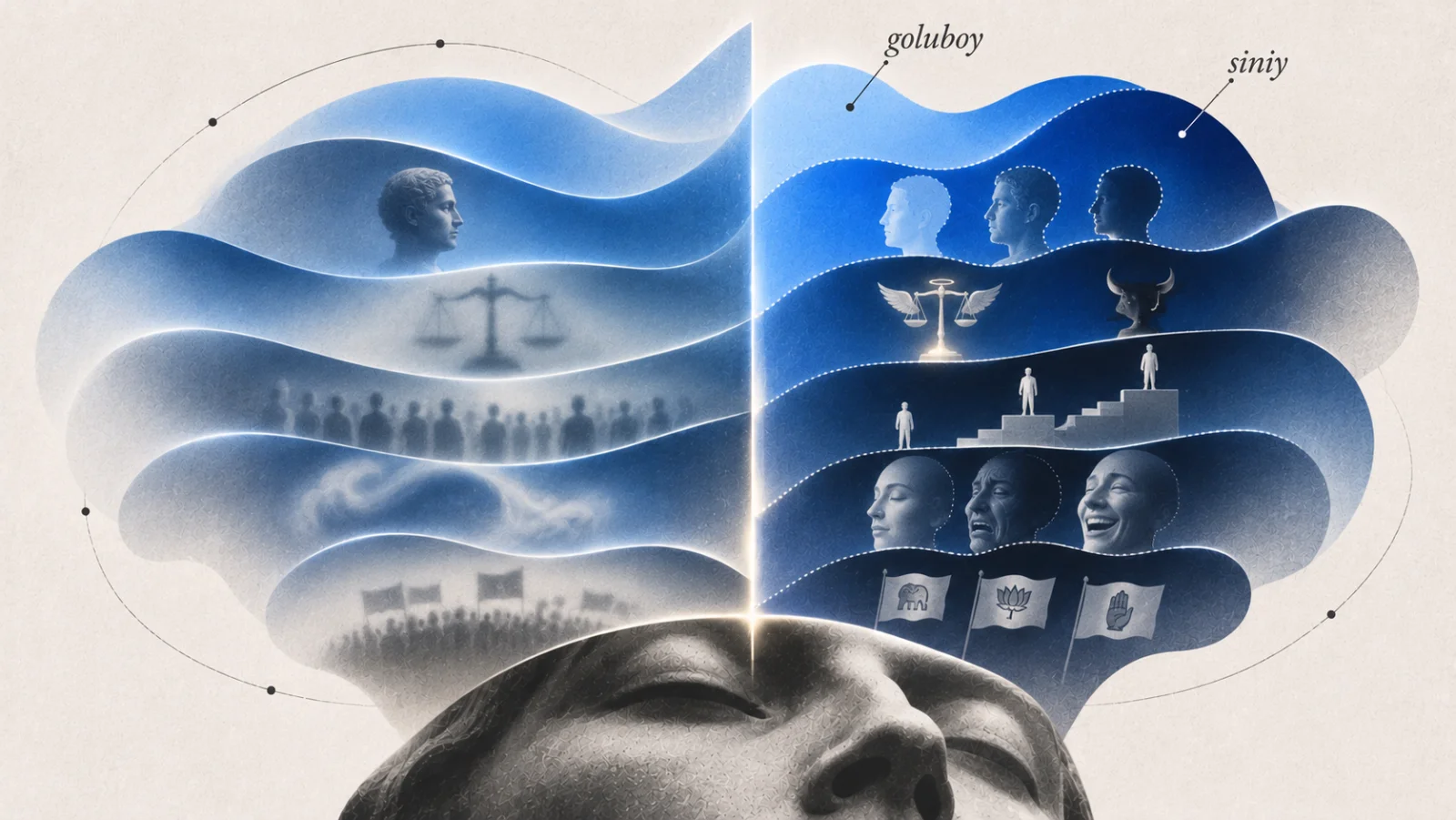
English uses the general term blue for a broad range of shades. Russian, however, has two basic colour categories: goluboy for lighter blue and siniy for darker blue.
Researchers found that Russian speakers were faster at distinguishing shades of blue when those shades fell into different linguistic categories. Interestingly, introducing a verbal distraction eliminated this advantage.
In other words, linguistic categories were influencing performance in a fairly basic perceptual task.
This is particularly interesting because it suggests that language doesn’t simply help us describe differences we have already noticed. It can influence how readily we notice certain differences in the first place.
The distinction exists in the physical spectrum regardless of what we call it. But having an established linguistic category makes that distinction more cognitively accessible.
Now extend this beyond colours.
Our societies have thousands of categories for describing intelligence, morality, social status, emotional experiences, political identities and human behaviour. Each category gives us a particular way of dividing an otherwise continuous and complicated reality.
Some distinctions become extremely familiar because our language constantly reinforces them. Others remain relatively invisible because we lack the vocabulary or cultural emphasis to recognise them.
We don’t necessarily experience everything that exists. We experience what our cognitive systems are equipped to recognise. (Winawer et al., 2007)

04 — Language as cognitive technology
Perhaps the strongest evidence for the relationship between language and cognition comes from research on numbers.
A 2004 study by Pierre Pica and colleagues examined numerical cognition among speakers of Mundurukú, an Indigenous Amazonian language with a relatively limited vocabulary for exact numbers.
The researchers found that participants could compare and perform approximate calculations involving relatively large quantities. However, they struggled with exact arithmetic involving numbers beyond approximately four or five.
The distinction is important.
Their ability to understand quantities had not disappeared. What was significantly more difficult was manipulating exact numerical representations without an extensive linguistic counting system.
This suggests that number words function as a kind of cognitive technology. They allow us to hold exact quantities in memory, manipulate them symbolically and perform operations that would otherwise be considerably more difficult.
Think about what mathematics has enabled human civilisation to accomplish. The development of symbolic numerical systems made it possible to accumulate increasingly sophisticated mathematical knowledge across generations.
Language, in this sense, isn’t merely describing mathematical reality. It provides tools for operating on it.
The same principle extends to other domains. Concepts allow us to accumulate knowledge beyond our individual experiences. They make complex ideas transferable, discussable and improvable.
A civilisation doesn’t have to rediscover everything from scratch because its knowledge can be encoded, transmitted and modified through shared systems of meaning. (Pica et al., 2004)

05 — Culture is a system of accumulated attention
This brings me back to my original question. Why do different cultures develop such different strengths?
I think the interesting direction is to stop treating cultures as collections of inherent characteristics and start examining them as systems of accumulated knowledge, habits, institutions and priorities.
Human cultures develop through generations of social learning. People inherit practices, technologies, beliefs and knowledge systems, modify them and pass them onwards. Research on cumulative cultural learning shows how these inherited systems are shaped by socialisation, education, institutions and the environments in which people grow up.
Language is central to this process because it allows knowledge to become collective rather than remaining restricted to individual experience.
But language is only one component. Geography determines certain practical demands. Institutions create incentives. Economic structures influence which skills are rewarded. Education determines which forms of knowledge receive investment. Historical circumstances determine which practices survive and evolve.
These factors interact rather than operate independently.
A community that repeatedly navigates a particular environment may develop sophisticated spatial knowledge. A society that invests heavily in mathematical education and technical institutions may accumulate considerable mathematical expertise. Neither outcome should be reduced to an inherent cultural characteristic.
The fascinating question is how these systems reinforce one another over time.
What a society repeatedly practises becomes easier to transmit. What it transmits becomes part of its collective knowledge. What becomes collective knowledge influences what future generations learn to notice, value and develop.
Language helps maintain this cycle. (Legare, 2019)

06 — Perhaps intellectual freedom begins with questioning your vocabulary
There is another dimension to all this that I find particularly interesting.
We tend to believe our thoughts are independent simply because we experience them internally. But our thoughts are populated by concepts we did not invent, distinctions we did not establish and definitions we rarely question.
We inherit ideas of success, intelligence, beauty, masculinity, happiness, morality and even what constitutes a meaningful life. Eventually, these become the standards through which we evaluate ourselves and everyone around us.
And because these categories are familiar, they acquire an almost unquestionable quality.
This is where intellectual curiosity becomes important. It is not simply about accumulating more information. It is also about developing the ability to interrogate the frameworks through which information acquires meaning.
Learning another language, exploring another discipline or encountering an unfamiliar culture can be intellectually liberating precisely because it exposes us to alternative conceptual systems.
You begin to realise that the way you have understood something is not necessarily the only way it can be understood.
Perhaps that is also why interdisciplinary thinking is so valuable. Psychology, anthropology, philosophy, neuroscience and economics don’t merely offer different answers to the same questions. They often offer different ways of defining what the questions themselves should be.
And maybe that’s the most interesting part of this entire subject.
We spend so much of our lives trying to find better answers, without realising that sometimes we need to question the language in which the questions were originally constructed.
I started reading about languages because I wanted to understand why different cultures develop different ways of interacting with the world. I ended up thinking about something much closer to home. How much of my own understanding of reality is actually inherited?
The vocabulary I use to understand success, the categories I use to judge people, the metaphors through which I interpret my experiences. How many of these have I consciously chosen?
I’m not entirely sure.
But I find it quite amusing that we’re all walking around with these incredibly complicated operating systems installed in our heads, most of which we didn’t even get to review before accepting the terms and conditions.
Perhaps the beginning of independent thinking is realising that the world is considerably larger than the language through which we have learned to see it.